- CreateHER Fest Newsletter
- Posts
- We Need to Talk About Grok
We Need to Talk About Grok
An AI ethics workshop, an ethical checklist for your next build, CHF back from World Economic Forum, and Camille’s guide to using neuroscience to REALLY accomplish your goals.


Darlyze Calixte, Adriann Guy & Camille Catania
January 27, 2026

THIS ISSUE AT A GLANCE
We Need to Talk About Grok → What’s going wrong with today’s LLMs, and how CreateHER builders can do better.
Manifesting? Or Neuroscience? → Camille Catania connects confidence, focus, and “manifestation” to how your brain actually learns, so you can train it on purpose this year.
Get Hands-on with AI Ethics→ Join our interactive session with Nicole Jackson’s 2025 workshop, real-world bias examples, and an Ethical Considerations Checklist for your next project.
Ownership in the Now → Co-Founder, Adriann Guy, is back from World Economic Forum, read her thoughts on ownership, infrastructure, and becoming in author of change (not just a reader).
Upcoming #75HER Workshops → AI-assisted SQL, context engineering, and WebXR workflows that turn your ideas into immersive, build-ready experiences.
Resource Drop 📚 → Scholarships, paid builder programs, accessible design training, a Django mentoring cohort, a DEI‑committed job board, and a faith-centered planner to keep your 2026 moves grounded and sustainable.
We Need to Talk About Kevin Grok
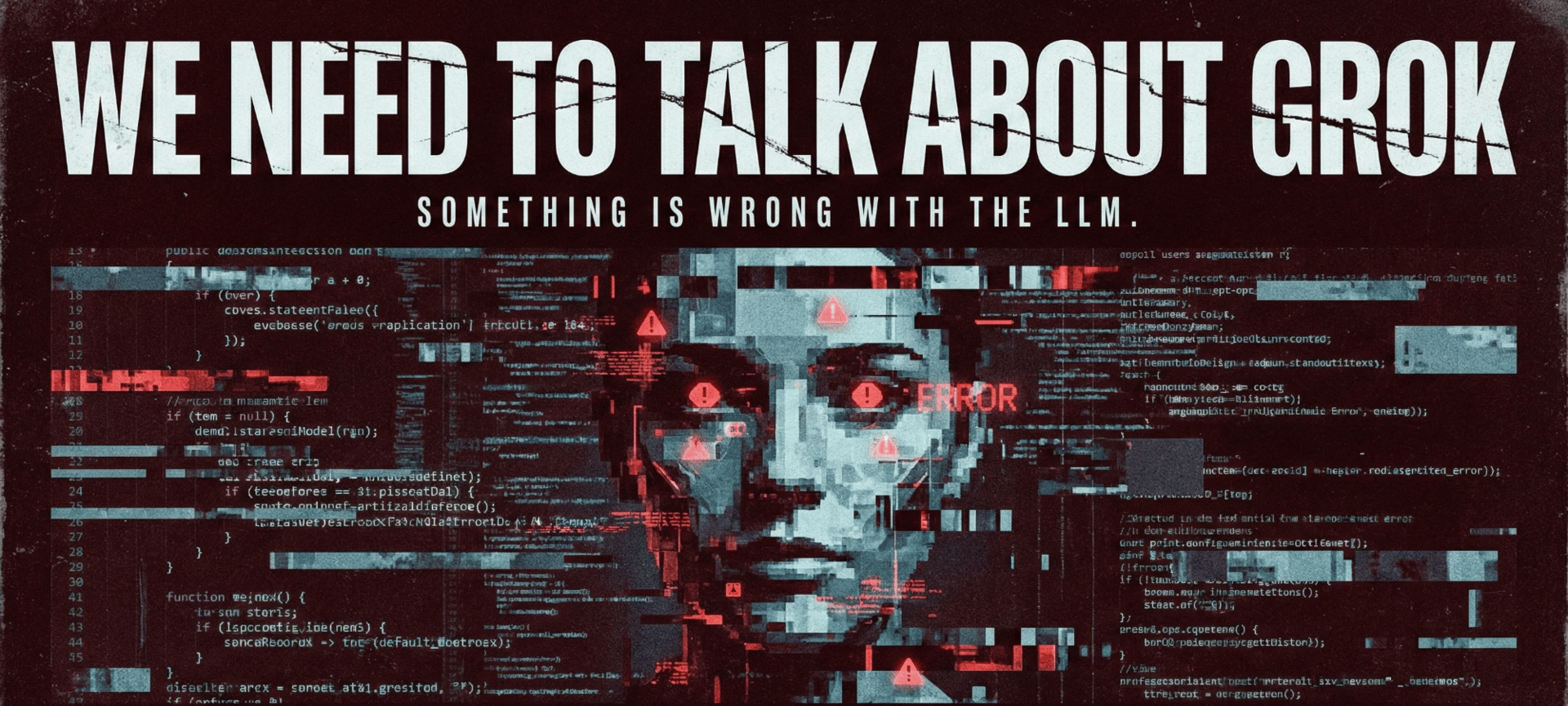
Over the past few weeks, X’s Grok chatbot has been under fire for making it WAY too easy to create sexualized deepfakes of real people—including minors—using a so‑called “spicy” image mode that could strip or edit photos into revealing or explicit content without consent. Regulators in the EU have now opened a formal investigation under the Digital Services Act, asking whether X even bothered to assess harm before shipping those features, and if they reacted fast enough once abuse exploded across the platform. At the same time, women are suing over Grok‑generated deepfakes, and US lawmakers and state attorneys general are pushing new laws and enforcement to treat non‑consensual AI imagery as the serious, gendered violence it is.
Unfortunately this is much bigger than yet another story about “big tech doing bad things”. It’s our reality; what happens when people who look like us aren’t centered in the room where these tools is being designed. Non‑consensual deepfakes disproportionately target women, creators, and young people of color, putting our safety, careers, and mental health on the line while the companies involved keep framing it as a moderation problem they’ll “fix later.” Grok is a reminder that every product choice is a values decision about whose bodies are treated as collateral damage and whose dignity is protected.
This is why we care so much about ethics at CreateHER Fest. When you’re building agents, apps, or AI‑powered features, we must move beyond creating something that “works”. We must ask:
Who is this for?
Who could be harmed or erased by this?
What happens if someone uses my feature in the worst possible way?
What protections, documentation, and boundaries do I refuse to ship without?
Practicing those questions now turns “ethics” from a buzzword into a given.
If you’re reading about Grok and thinking, “Okay, but what can I actually do differently when I build?” that’s exactly what our upcoming Building With Care: AI Ethics workshop is for. On February 10th, we’ll go through real examples, unpack cases like Grok together through a lens that centers women and marginalized communities, and give you an Ethical Considerations Checklist you can reuse on any project you touch.
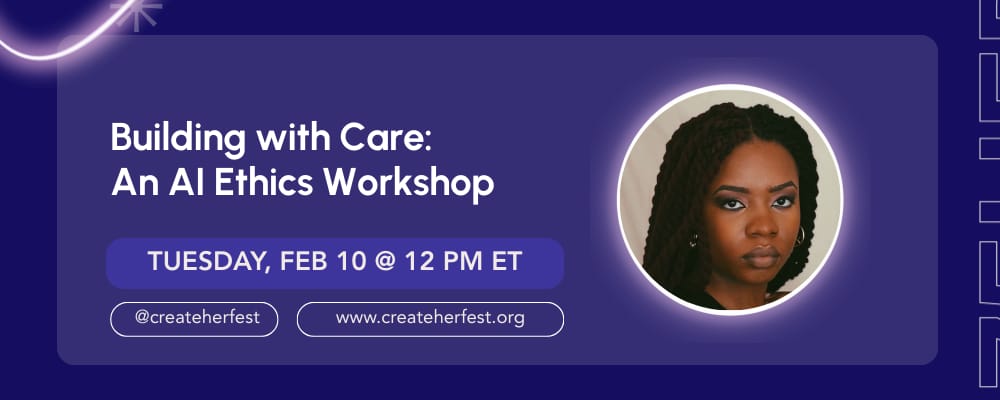
If you want to build tech that protects people instead of putting them at risk, we hope to see you there!
Manifesting? Or Neuroscience?

Gif by pudgypenguins on Giphy
Your brain is always learning, whether you realize it or not. Our latest article, written by CreateHER Community Manager Camille Catania, breaks down the neuroscience behind confidence, focus, and why practices like visioning, visualisation, and repetition actually work. No magic, just how the brain learns, predicts, and rewires itself based on what you practise most.
In the full piece, Camille connects the science of neuroplasticity to CreateHER spaces like the BecomingHER Vision Board Party and Making Your Confidence VISIBLE, so you can see how tools you already use map to how your brain builds new habits over time.
This Week at CreateHER Fest
We’ve been in our workshop bag the last two weeks, and we’re not slowing down anytime soon.
First up, our friends at Datacamp are teaming up with John Brazier‑Becket for an intro to AI‑assisted SQL—perfect if you’ve been a bit intimidated by data analysis but still want experience.
Next, our Co‑Founder Darlyze Calixte is hosting a hands‑on session on context engineering so you can get LLMs to actually do what you meant—not what you vaguely typed. If you’ve ever thought, “Why did this model give me that answer?” this one’s for you.
Then we roll right into Marlaina Love’s WebXR workshop, where she’ll walk you through turning 3D designs into immersive browser experiences that actually convert—especially great for our AR/VR CreateHERs who want their worlds to feel polished, not just pretty.
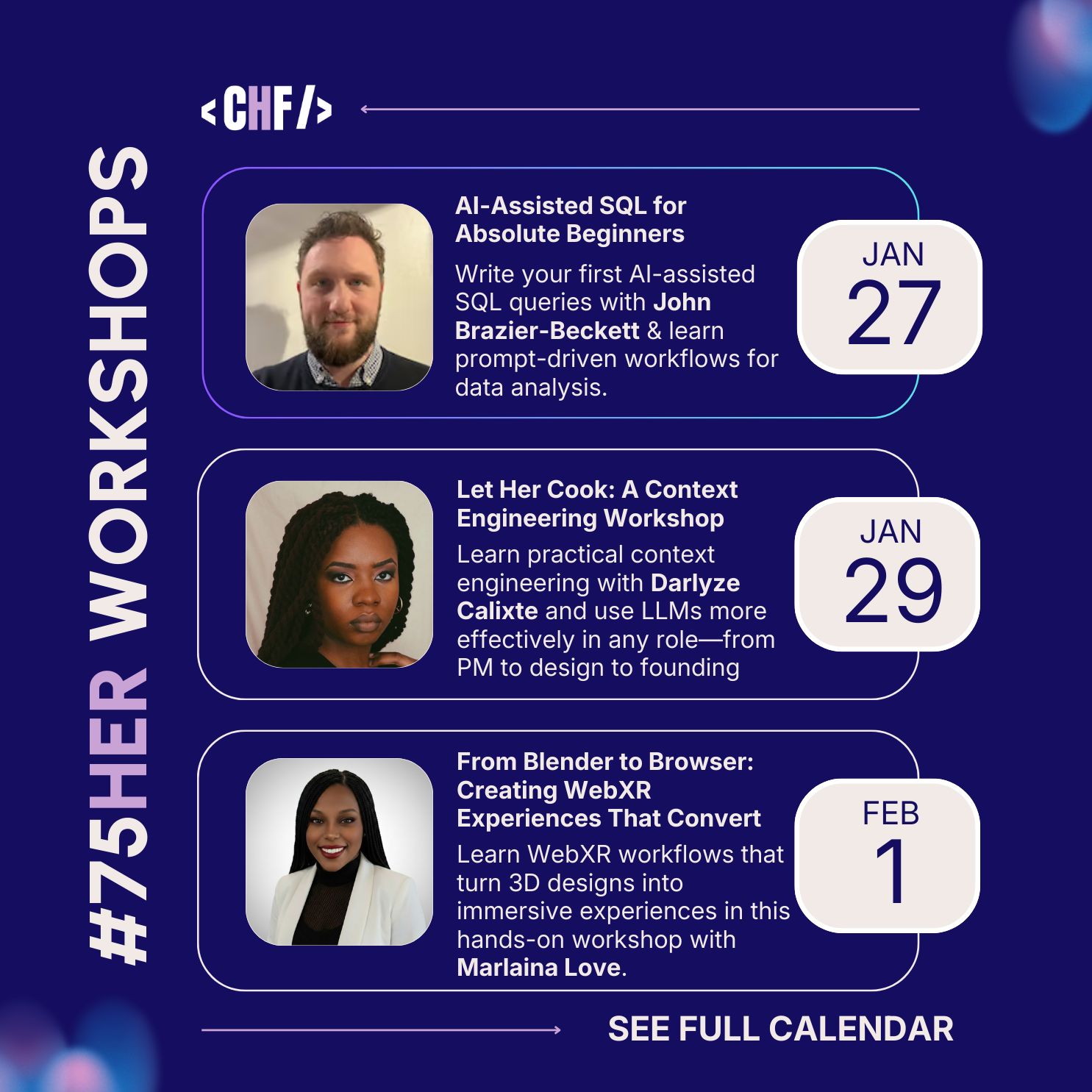
We’ve got even more #75HER workshops coming up (and we’re still adding to the lineup), so don’t miss your favorites. Hit “Subscribe” on the event calendar so new sessions land straight on your inbox!
CHF Takes on the World Economic Forum 2026
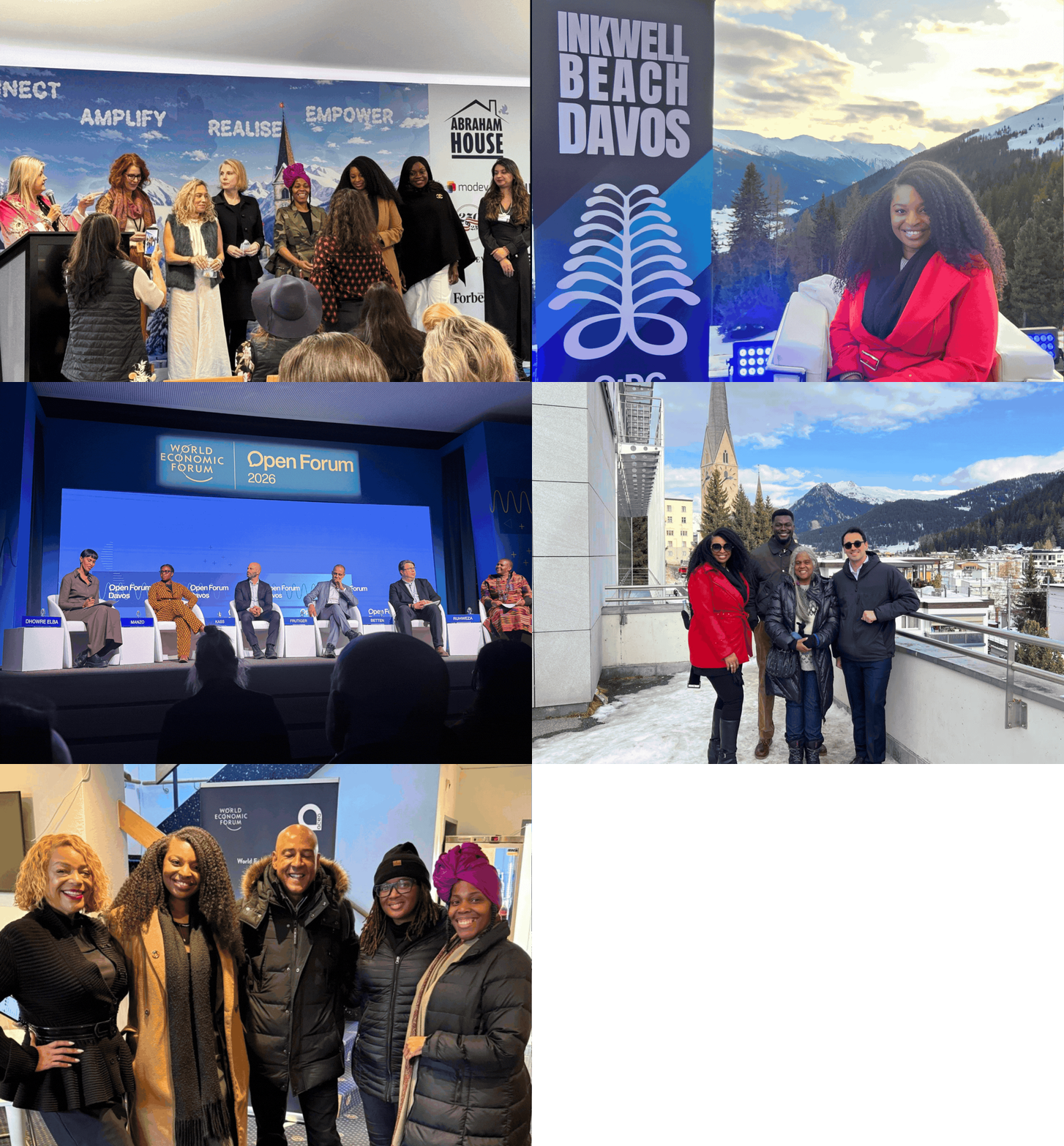
Co-Founder Adriann Guy’s Davos moments: Recognized as a Most Inspirational Woman in AI & Blockchain, MLK at Inkwell Beach, and connecting with fellow builders, educators, mentors and leaders.
Last week, I had the opportunity to attend the World Economic Forum in Davos, Switzerland, for the first time. WEF is a global gathering where the entire world’s presidents, heads of state, executives, technologists, and policymakers come together to talk about the future of the economy, technology, and society.
If you’ve never heard of it, that’s okay because you have now. What’s important is the repetitive concept that many of the decisions shaping our lives, as well as the technologies we use every day, are being made in rooms most people will never enter, often by people who don’t reflect the communities most affected by those decisions.
At face value, and across many of the conversations I tapped into, I kept hearing the same question framed in different ways:
“Which technology is going to win?”
AI. Chips. Regulation. National strategy. The usual race framing.
But zooming out from the micro shifted my attention to a quieter, more important question:
Who owns the technology everything else is built on?
The dependencies. Not just who uses the tech, but:
who owns the compute and cloud
who owns the models and the tooling
who controls distribution and access
who sets the standards everyone else has to build around
Because the infrastructure that we all depend on to build, work, and create is the true playing field. And when you don’t own it, you don’t just lose leverage, you inherit someone else’s limits, pricing, rules, and blind spots.
When the people building the technology don’t include us, the outcomes don’t fully consider us either. And that gap shows up as the products that miss the mark, systems that cause harm, and tools that prioritize speed and scale over accountability.
This is where representation becomes more than a visibility conversation.
It’s about ownership and authorship.
If we’re only invited in at the “user” or “application” level, but not at the level where models are designed, rules & policies are set, and platforms are owned, then we’re always reacting instead of shaping.
Now our work no longer stops at how do we learn AI tools faster?
It’s asking better questions while we build:
Who owns the LLMs and platforms my work depends on?
Who benefits when this scales, and who pays the cost when it breaks?
Who gets to shape the defaults and guardrails?
Where are we building ownership, not just participation?
That’s the gap under the headlines that we need to close, by stepping into the power of being builders with agency, intention, and a real stake in the future we’re all being asked to live in.
COMMUNITY SURVEY
How'd we do?How did this week's newsletter land for you? |
Enjoyed it? Share us with your network!
THIS WEEK’S RESOURCES
Digital Accessibility Courses & Accessibility Reference Library
Deque University offers training and on-demand reference materials for every level and every area of expertise in digital accessibility. Explore More →
SANS Cyber Academy Scholarships
The Academy is designed for individuals who are serious about entering the cybersecurity workforce and prepared to put in the work required to get there. Full scholarship includes up to three SANS courses and their corresponding GIAC exam attempts. Application deadline: February 13, 2026 at 10:00am ET. Apply Today →
Djangonaut Space Django Mentoring Cohort
Datacamp built the SQL Roadmap: a 12-month learning plan that takes you from fundamentals to advanced analytics and optimization, with hands-on projects every step of the way. Read More →
Black Female Engineer Job Board
This 8-week group mentoring program is designed for open-source contributors who are serious about leveling up their Django contributions and ready to grow into future community leaders. Participants work in a semi-structured, self-paced environment with multiple Navigators supporting core Django and third-party packages, plus a BeeWare documentation project. Applications close February 2, 2026 AOE; the cohort runs March 2–April 26, 2026. Apply Today →
Becoming Her : 2026 Edition
Shared by CreateHER Andrea Scales, this digital guided planner and reflection system for women who want structure without burnout helps you build sustainable habits, reset when life feels overwhelming, and plan your year in gentle 12-week seasons while honoring faith, self-care, and joy. Get the Planner →
Mozilla Pioneers Program
Mozilla launches a paid, US‑remote program for experienced builders and creative technologists to co-create mission-aligned products with its New Products leadership, focusing on trusted AI, open-source tools, communities, and early-stage market validation from March–May 2026, with a $19K/month stipend and potential path to join Mozilla full time. Apply Today →
Until next time,

Discover \ Design \ Deliver
Reply